It’s no secret that the U.S. is staring at a massive infrastructure maintenance backlog as we head toward 2027.
While it’s an issue that has compounded over the course of decades, it’s definitely moving to the forefront now. In almost every city across the country, people are getting fed up with the poor state of roadways, bridges, and other infrastructure. Unfortunately, for many cities and municipalities, the math seems to be getting worse, not better.
A Look at the Numbers
Deferred transit maintenance alone now tops 140 billion dollars, while public owners scramble to deploy tens of billions in new spending in 2026 and 2027 just to keep systems from falling further behind.
At the same time, NOAA has placed El Niño conditions under advisory for 2026, with a high probability that the event strengthens into winter 2026–27, increasing the odds of extreme precipitation, flooding, and weather volatility that will stress already vulnerable structures.
From our perspective inside the industry, none of this is exactly surprising. Decades of lowest‑bid procurement and short‑term thinking led many teams to approach concrete specification as a box‑checking exercise rather than a long‑term risk calculation.
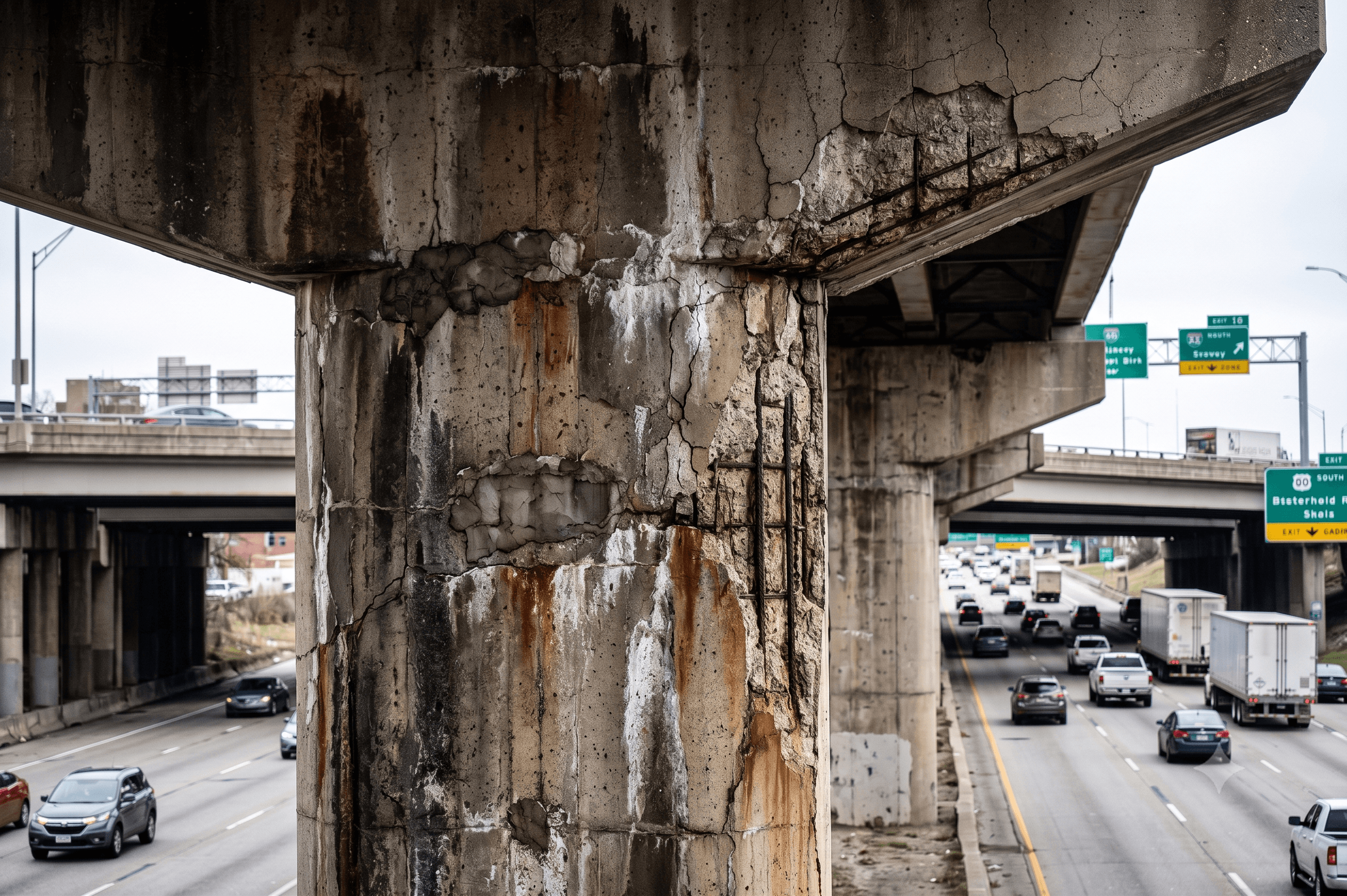
The result is what we see today: bridges, tunnels, retaining walls, sea walls, garages, and tanks that reach their “maintenance moment” far earlier than their design life should allow.
One way to look at it: the backlog is a specification problem in disguise.
Infrastructure Maintenance Isn’t an Overnight Requirement
When you zoom out, the infrastructure maintenance backlog is not just about aging assets, it is about the choices that were baked into those assets from day one. On the concrete side, three patterns show up again and again:
- Treating waterproofing as an accessory instead of an critical performance requirement.
- Assuming that corrosion can be “managed later” with coatings, patching, or replacement.
- Optimizing up front cost without quantifying lifecycle exposure to water, chlorides, and freeze‑thaw cycles.
In an El Niño year, those assumptions become more expensive. Higher odds of intense rainfall events, coastal flooding, and saturated soils mean more hydrostatic pressure against walls, more water migration through slabs, and more aggressive environments for steel reinforcement.
Wherever concrete was specified to be minimally compliant instead of resilient, owners now pay for more frequent inspections, crack injection programs, joint repairs, and emergency interventions that compete with capital budgets.
Better Concrete Specification Changes the Math and ROI
From a Hycrete standpoint, the path forward seems straightforward: move durability and permanent waterproofing into the core of the specification, not the value‑engineering worksheet. Hycrete technology makes concrete waterproof on delivery, reducing absorption to less than 1% while simultaneously protecting reinforcing steel from corrosion.
Basically, Hycrete changes the lifecycle math. There are several inherent advantages when designers or owners specify hydrophobic integral waterproofing with dual corrosion protection up front:
- Water infiltration is dramatically reduced, so you do not “start the clock” on corrosion as soon as the structure is exposed.
- The number and severity of maintenance interventions over the first 20 to 40 years drops, freeing up budget for true modernization rather than emergency repair.
- Contractors can simplify detailing and sequencing compared to complex membrane systems, reducing installation risk and variability.
In practical terms, that all means a retaining wall or transit structure is less sensitive to the kind of severe weather swings associated with El Niño and other climate patterns. It is not just meeting spec on day one, it is still meeting spec under harsher conditions twenty years later.
Contractors Meet the Spec, but the Spec Doesn’t Meet Reality
To be fair, most contractors delivered exactly what they were asked to build. They met the written specifications, installed the membrane or coating system selected at the time, and hit the required compressive strength numbers. The gap sits between those specs and the actual exposure conditions.
If a design team treats “waterproofing” as a line item rather than a measurable performance target, then value engineering tends to favor the least expensive acceptable option. Owners may save money up front, but the structure will likely reach its first major rehab cycle sooner, especially in areas with deicing salts, coastal spray, or high groundwater.
With Hycrete, we encourage customers to frame waterproofing and durability as non‑negotiable performance criteria. Hycrete is generally 20 to 30 percent less expensive than an installed membrane, yet it provides permanent protection and extends the functional lifespan of infrastructure assets. That is how you start shrinking a backlog rather than feeding it.
We See Countless Examples in Infrastructure, Housing, and Campuses
Across infrastructure, housing, and campus construction, we see the same story: where permanent waterproofing and corrosion protection are specified up front, owners spend less time fighting water and more time benefiting from their assets.
Hycrete has been used extensively in DOT and municipal infrastructure, in sea walls, wastewater systems, transit structures, and below‑grade tanks, all environments where water and chlorides are relentless.
In major campus projects like the University of Washington Medicine facilities, the Google and Expedia campuses in Seattle, and Bay Meadows in San Francisco, hydrophobic integral waterproofing with Hycrete has helped developers avoid pumps, membranes, and complex detailing while still protecting deeply buried parking slabs under hydrostatic pressure.
In each of these cases, the specification decision was made early, but the benefit accumulates for decades. Owners gain predictable performance, lower maintenance frequency, and more control over lifecycle cost, even as climate volatility increases.
Hydrophobic Integral Waterproofing: Future-Proofing U.S. Infrastructure One Project at a Time
- Concrete that is waterproof on delivery, not dependent on membrane integrity.
- Structures that tolerate more aggressive moisture and chloride exposure without premature deterioration.
- Lower installed cost compared to many membrane systems, with better long‑term ROI.
The maintenance backlog did not appear overnight. It is the aggregate result of millions of conservative, short‑term choices. To change the math, we have to change those choices. That starts by writing durability and permanent waterproofing into the spec, and by building infrastructure that is ready for El Niño years, not just average ones.
If you are planning a new infrastructure, industrial, or campus project and want to quantify the lifecycle impact of hydrophobic waterproofing versus legacy systems, we can offer a side‑by‑side cost and risk analysis review tailored to one of your upcoming projects.