It’s well-known that freeze-thaw cycles are one of concrete’s biggest enemies. Whether you’re dealing with roads, bridges, or buildings, freeze-thaw cycles wreak havoc once you have water penetrating beyond the surface.
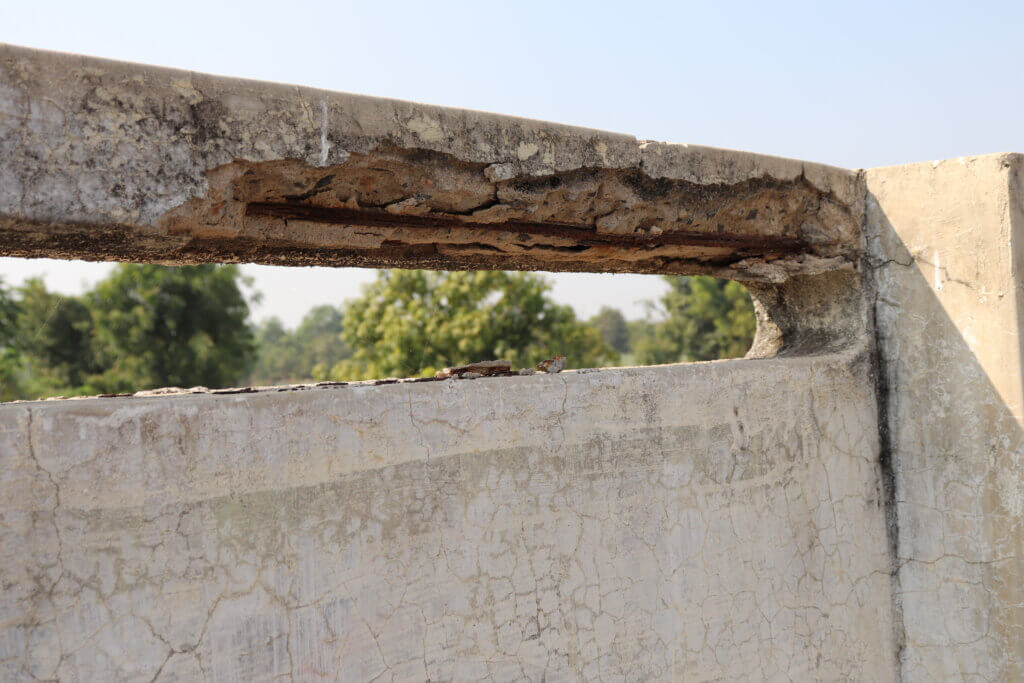
We’ve talked extensively about moisture penetration and the resulting corrosion issues that take hold over time. However, when you add freeze-thaw cycles into the mix, the damage can easily be accelerated and much more extensive. Surface spalling, spiderweb cracks, and significant structural damage can start to take hold over the course of one harsh winter season.
Despite concrete’s inherent durability, it faces a persistent threat throughout most of the U.S. where freeze-thaw cycles are a regular occurrence. Implementing advanced waterproofing technologies like Hycrete can mean the difference between decades of reliable performance and costly premature failure.
The Science Behind Freeze-Thaw Damage in Concrete
Concrete, while incredibly strong under compression, possesses an inherent vulnerability: it’s naturally porous. If you zoom in close, it almost looks like a sponge.
During the mixing and curing process, water creates a network of microscopic capillaries and pores throughout the concrete matrix. Even after complete hydration, these interconnected pathways remain, allowing water to penetrate deep into the material structure.
The freeze-thaw cycle begins when moisture-saturated concrete encounters freezing temperatures. When water freezes, it expands by approximately 9% in volume. That may seem negligible, but the forces generated within the confined spaces of concrete pores can reach several thousand pounds per square inch. To put the number in perspective, standard concrete mixes typically have a tensile strength of only around 300 to 700 psi.
How the Damage Is Done
As water freezes in the concrete pores, the volumetric expansion creates tensile stress that concrete resists poorly, as it’s a material designed primarily for compressive strength. In turn, the expansion acts like thousands of microscopic wedges simultaneously pushing outward against all the walls of the pours inside.
When the concrete cannot accommodate this expansion, micro-cracking begins. As temperatures rise and ice melts, the newly formed cracks fill with even more water, penetrating deeper into the structure. The next freeze cycle expands these cracks further, and the cycle continues with compounding severity.
Progressive Deterioration: From Surface Spalling to Structural Compromise
Freeze-thaw damage manifests in several distinct forms, which become progressively more severe if left unchecked. The earliest sign is typically surface scaling: a gradual flaking that begins as fine dusting and evolves into noticeable peeling of the concrete surface. Horizontal surfaces like sidewalks, driveways, and parking decks are particularly vulnerable because they accumulate standing water that penetrates deeply before freezing.
As deterioration progresses, spalling becomes increasingly evident. More and more concrete fragments break away from the surface. Shallow craters and rough patches result, which are not only unsightly: they expose the underlying aggregate to water ingress and accelerated freeze-thaw damage.
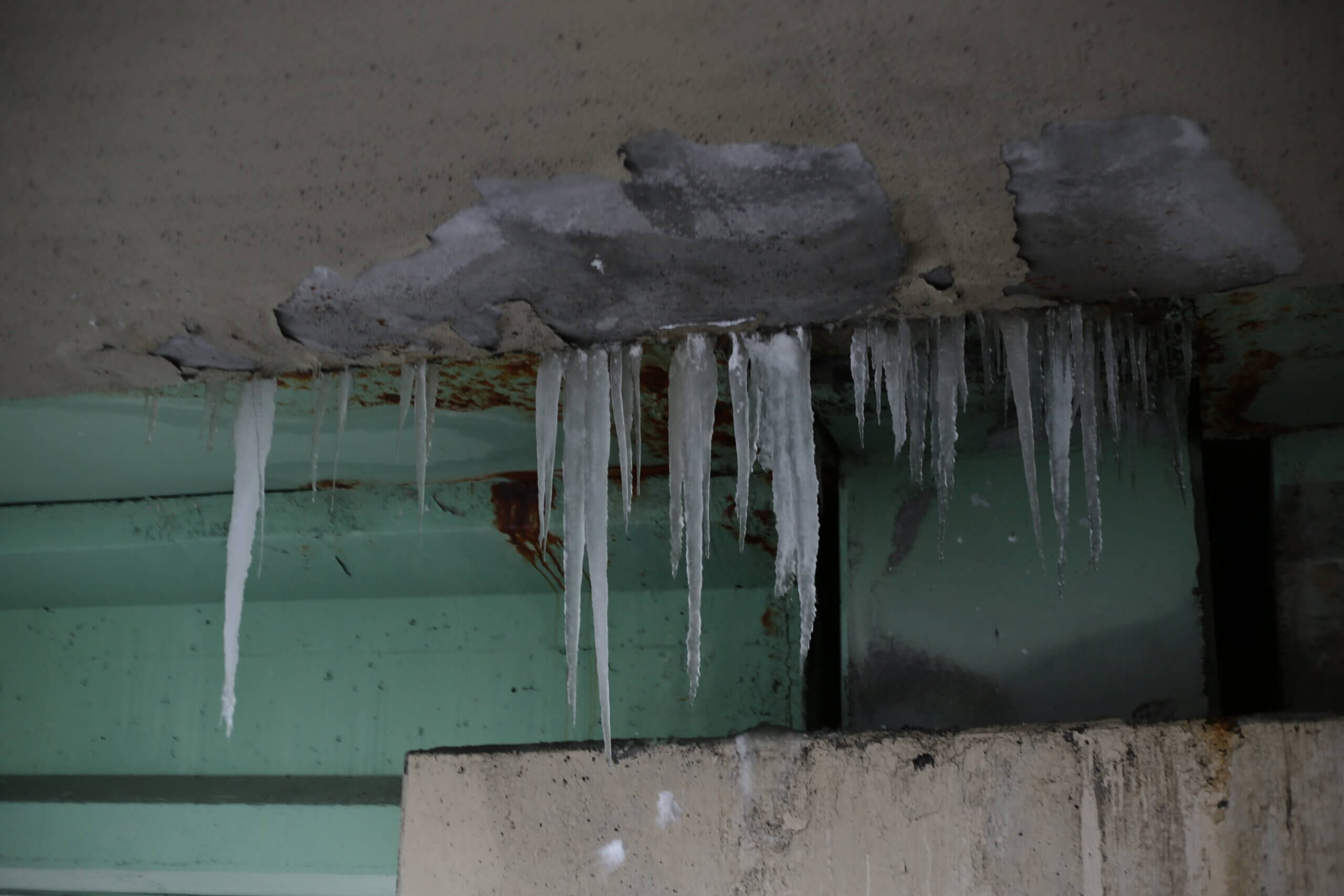
Spalling occurs when hydrostatic pressure (typically from freezing water or osmotic pressure from dissolved salts) exceeds the concrete’s tensile strength. That pressure essentially blows the surface layer off the material. North-facing surfaces are usually even more susceptible because they receive less direct sunlight, allowing moisture to remain longer and freeze more thoroughly.
But the most significant damage happens on the inside. Internal cracking may not be immediately visible, so it can compromise structural integrity long before external symptoms appear. Meanwhile, the subsurface fractures create pathways for water to reach steel reinforcement, initiating corrosion that further weakens the structure. The reinforcing steel expands as it corrodes, creating additional cracking in a destructive feedback loop that leads to decreased load-bearing capacity in columns, beams, and foundation walls.
Hycrete Technology: Molecular-Level Protection Against Freeze-Thaw Cycles
Hycrete takes a fundamentally different approach to concrete waterproofing. Rather than applying external barriers that can fail, degrade, or be improperly installed, Hycrete makes the concrete itself intrinsically waterproof from the inside out. It’s a chemically-advanced hydrophobic liquid admixture added during the mixing process, where it reacts with metallic ions in cement to form a performance copolymer that fills the concrete’s natural capillary system at the molecular level.
As a result, Hycrete reduces water absorption in concrete to less than 1 percent, the highest-performing waterproofing technology available in the market today. Independent laboratory testing consistently demonstrates Hycrete-treated concrete performing in the 0.3 to 0.9 percent water absorption range. The concrete is rendered virtually non-porous and highly resistant to moisture vapor and liquid transport.
Tested by the New England Transportation Consortium in accordance with ASTM C666, Hycrete-treated concrete exhibits exceptional resistance to rapid freezing and thawing, meeting the harsh demands placed on concrete used in severe winter weather conditions. This rigorous test includes 300+ cycles, with Hycrete consistently returning durability readings of 90+.
Performance and Longevity Proven by Science
Fluorescence microscopy testing conducted by the Swedish Concrete Research Institute provides visual confirmation of Hycrete’s effectiveness. Cross-sectional analysis reveals that the natural pores and capillaries are completely filled with hydrophobic polymers, creating a continuous moisture barrier distributed uniformly throughout the concrete matrix rather than relying on incomplete crystal growth or surface treatments.
Explore Hycrete’s extensive testing results, and see how the competition compares in the Hycrete Testing Summary.
Proactive Protection for Climate Resilience
Climate stressors like freeze-thaw cycles, hydrostatic pressure, salt exposure, and moisture intrusion all pose significant threats to concrete infrastructure. The progressive nature of freeze-thaw damage means that early intervention is far more cost-effective than remediation after structural deterioration becomes visible. By the time surface spalling appears, extensive internal damage has typically already occurred.Hycrete technology addresses these challenges at the molecular level, transforming concrete from a moisture-permeable material into a highly waterproof, freeze-thaw resistant composite. With water absorption reduced to less than 1%, engineered air entrainment providing pressure relief, and comprehensive protection against hydrostatic pressure and salt penetration, Hycrete delivers the weatherproof performance that modern infrastructure projects demand.