Radon is a naturally occurring radioactive gas that poses significant health risks as one of the leading causes of lung cancer. As the risks for building occupants have become better understood, radon mitigation is increasingly a focal point within safe, sustainable building practices.
Particularly with new data center construction projects, which have proliferated throughout 2025 and now into 2026, it’s a concern on many builders’ minds. Beyond creating the safest facilities possible, everyone is likewise looking to get ahead of potential future regulations and shore up their long-term ROIs.
However, minimizing radon exhalation is easier said than done, especially in a way that’s fully reliable, long-lasting, and cost-effective.
It’s another reason why integral concrete protection such as Hycrete admixtures is becoming more and more essential: as health and safety regulations continue to evolve, conventional untreated concrete is simply no longer the standard. Hycrete admixtures not only address waterproofing and corrosion protection, but also demonstrate a substantial reduction in radon exhalation, positioning it as the optimal choice for data-driven, future-ready construction.
Radon Exhalation Explained: What Are the Risks?
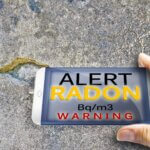
Radon is a mono-atomic, colorless, odorless radioactive gas released through the natural decay of uranium-bearing minerals naturally present in soil, rock, as well as concrete and building materials. When radon enters indoor environments, particularly through foundational materials like concrete, it can accumulate to hazardous levels.
Chronic exposure to elevated indoor radon significantly increases the risk of lung cancer. In fact it has been identified as the second leading cause of lung cancer deaths, with non-smokers most at risk. According to the EPA, radon is responsible for about 15,000 lung cancer deaths annually in the United States alone.
Hycrete: A Proven Solution to Minimize Radon Exhalation
Recent peer-reviewed studies and industry research confirm that Hycrete admixtures significantly reduce radon exhalation rates in concrete. By forming a hydrophobic barrier within the concrete matrix, Hycrete effectively clogs pores and capillaries that would otherwise allow moisture and radon to migrate toward the surface.
In controlled long-term experiments, concrete containing Hycrete admixture outperformed both control samples and fly ash-modified concrete, achieving a reduction of up to 35% compared to fly ash under moist conditions, consistently outperforming alternative mitigation methods. See the Hycrete Testing Summary for a full rundown of the results:
Hycrete admixtures address not only waterproofing and corrosion, but the diffusion length of radon. In effect, less radon leaks out into indoor environments, while water and corrosion are prevented from getting in.
Why Alternatives Fall Short
Conventional membranes and surface sealants may reduce radon intrusion only if flawless application and substrate integrity are maintained. Unfortunately, that’s nearly impossible to achieve in large builds, or over extended timelines. As the membrane or sealant breaks down, radon exhalation only increases over time.
Data Center Construction: Driving the Industry in 2026 Forward
Data center construction is driving historic growth in the non-residential building market, with 2025 spending projected to exceed $46 billion, doubling the previous year’s high. Just a decade ago, data center construction accounted for only 4 – 5% of commercial/office construction. That number is now more than 30%, and it’s projected to surpass 40% by 2028.
The demands of this burgeoning industry have brought radon exhalation and indoor air quality closer to the forefront as regulatory scrutiny intensifies. Site selection for data centers increasingly targets regions with known radon risk, making material choices that minimize radon emission essential throughout the design-build process.
Hycrete’s dual-advantage of waterproofing and radon mitigation gives data center builders and owners a simpler, lower-risk, and more cost-effective approach to long-term protection. Standard concrete protection measures can be streamlined, avoiding membrane installation steps and weather delays, which is particularly valuable for rapid deployment schedules that are common in modern data center projects.
Supporting Better Building Strategies for Tomorrow
As the industry rapidly advances toward smarter, safer, and more sustainable buildings, especially in data center construction, the control of radon exhalation emerges as both a technical necessity and a differentiator in responsible construction practices.
Hycrete’s proven admixture technology directly addresses this challenge, delivering robust, long-term protection that reduces radon gas emission rates, simplifies construction schedules, and enhances occupant and equipment safety.
For forward-thinking projects demanding uncompromising sustainability and operational certainty, Hycrete is the safer, and demonstrably more sustainable solution for minimizing radon exhalation in concrete.